A landmark history of North Korea, told through the rise of the Kim Dynasty and its surprising ties to American Christianity—a spectacular, penetrating account of a world like no other
North Korea. The Hermit Kingdom. For eight decades, it has marched defiantly to its own beat, shaking off its Soviet and Chinese sponsors to emerge as one of the world’s most enigmatic nations—a nuclear-armed state ruled by a dictatorial dynasty unlike any the world has seen. Underpinning the state is a personality cult larger and more soaked in religiosity than those constructed by Stalin or Mao—one that, unbeknownst to the world, traces its roots back to the Christian fervor of post–Civil War America.
In Korean Messiah, Jonathan Cheng, The Wall Street Journal’s China bureau chief and former Korea bureau chief, takes us deep inside Pyongyang, a city once so dominated by Christianity it was known as “the Jerusalem of the East.” Cheng introduces us to Samuel Moffett, a Presbyterian missionary from Madison, Indiana, who would venture into Pyongyang at the turn of the nineteenth century and build a remarkable following—one that would include the very Kim family that today presides over one of the world’s harshest persecutors of the Christian faith.
At the center of this story—its messiah—is North Korea’s founder, Kim Il Sung, son of two fervent Christians and progenitor of an ideology known as Kimilsungism, an exercise in idolatry that has elevated him, and his successor son and grandson, to Christ-like status, from the humble manger where he was born to the subway seat on which the venerated leader once placed his posterior, cordoned off as if it were a religious relic.
Drawing on letters, diaries, and never-before-unearthed archival material that temper and oftentimes contradict the glorious historical record promoted by Kim Il Sung’s legions of hagiographers, Korean Messiah tells the true story of a country shrouded in fictions.
Korean Messiah: Kim Il Sung and the Christian Roots of North Korea's Personality Cult is a forthcoming work that seeks to trace the origins of North Korea’s intense personality cult to the Christian environment of Kim Il Sung’s youth. Drawing on interviews, letters, and newly available archival material, Wall Street Journal China bureau chief Jonathan Cheng argues that Kim’s early exposure to Christian education and theology shaped the centralized ideological system he later constructed to consolidate power.
This ambitious and deeply researched study opens with a detailed account of Christianity’s roots in northern Korea, beginning with the arrival of Presbyterian missionaries from the American Midwest in the late nineteenth century. Cheng traces the emergence of early house churches and the rapid growth of an extensive network of churches and schools centered around institutions such as the Pyongyang Central Presbyterian Church. These missionary efforts fostered the development of robust native Christian institutions that provided both spiritual guidance and social infrastructure. Mission schools offered formal education to many who had previously lacked access, promoted literacy through the Korean vernacular alphabet, and expanded opportunities for women beyond traditional domestic roles. Christianity also functioned as a moral and institutional bulwark against Japanese imperial rule. By the turn of the twentieth century, Pyongyang had earned the moniker “Jerusalem of the East” for its vibrant Protestant community.
Within this religiously dynamic setting, Cheng situates Kim’s formative years. Korean society, he argues, proved remarkably receptive to Christian proselytization—including members of Kim’s own family. Both of Kim’s parents and relatives on his mother’s side were active in the church. His father attended Western-style missionary schools and remained involved in church life; his mother was reportedly Presbyterian, and his maternal grandfather served as a Protestant elder. As one historian cited in the book observes, Kim’s parents were “not just Christians, but Christian activists.” During his family’s exile in Manchuria under Japanese occupation, Kim also developed relationships with veterans of the Korean Christian movement who had known his father. He attended schools influenced by Protestant missionaries, where he encountered Christian moral teachings, concepts of salvation, and highly structured forms of worship and collective mobilization. Cheng contends that these experiences left a lasting imprint on Kim’s understanding of leadership, organization, and ideological authority.
The core of Cheng’s argument is that Kim later drew upon these organizational and symbolic forms as he consolidated power in North Korea. As Kim emerged as the idolized leader of the new state, some contemporaries believed he instructed his cadres to emulate practices drawn from the churches of his youth. Kim was portrayed as a national savior and liberator; his writings were elevated to the status of canonical texts. Writers and poets described him as a “savior in the Christian mode.” Ritualized practices—mandatory gatherings, recitations, and self-criticism sessions—mirrored the cadence and structure of religious observance. Ideological codes of conduct carried a moral absolutism reminiscent of the Ten Commandments, while songs and chants echoed Western choral traditions. Some historians interpret this carefully cultivated deification as an attempt to present Kim as a “secular Christ,” effectively replacing Christianity with a state-centered political faith that used its forms.
In sum, Korean Messiah is an illuminating study that explores a neglected dimension of Kim Il Sung’s rise to power. Cheng’s research is impressively thorough, and his central thesis is both original and compelling. At times, however, the narrative becomes repetitive and digressive, which slightly diminishes the book’s cohesiveness (the author notes that the original manuscript exceeded one thousand pages). Moreover, while the Christian influence on Kim’s early life is convincingly documented, the argument may understate the multifaceted origins of North Korea’s personality cult. Marxism-Leninism, Korean nationalism, Confucian hierarchy, and broader patterns of totalitarian political religion likely also shaped the regime’s ideological architecture.
Nevertheless, Cheng delivers a deeply researched and thought-provoking account of how early Christian missionary activity may have contributed—symbolically and structurally—to one of the twentieth century’s most formidable cults of personality.
Thanks to NetGalley for providing me an advance copy of this work.
Korean Messiah is a fascinating account of Christianity in Korea and its influence on Kim Il Sung and the cult of personality built around him.
That cult is well known, but a few examples help illustrate its intensity: * Every North Korean household is required to display framed portraits of the Kim family in a place of honor, and residents are expected to dust them daily with a special cloth provided by the state. * State media regularly celebrates citizens who risk their lives to protect these images - one young girl was praised for running back into a burning building to save a portrait of the Dear Leader. * Citizens are expected to spend hours each day studying Juche, Kim’s ideological system; one party official suggested an ideal day consists of eight hours of sleep, eight of work, and eight of study. * Roughly half of primary school textbooks is directly about Kim Jong Un. * Thousands of study halls have been built for mandatory sessions on the Great Leader’s writings, often paired with self-criticism rituals in which citizens confess their ideological shortcomings. * All cultural institutions reflect this obsession: a visitor to the Pyongyang subway museum noted that it contained almost no information about the subway itself, instead focusing almost entirely on Kim, down to the pen he used to authorize its construction.
Kim’s cult began under Soviet influence, modeled on that of Joseph Stalin. But when Nikita Khrushchev later moved to dismantle Stalin’s cult and encouraged other Soviet-aligned states to follow suit, North Korea refused. Instead, the cult continued to expand until Kim came to be treated as something approaching a living god.
Much of Korean Messiah, however, focuses on an earlier period. The first two-thirds of the book traces the spread of Christianity in Korea from the late Joseon dynasty through the colonial era, despite sustained persecution.
The book’s central argument is that the deeply Christian milieu in which Kim was raised provided the structural template for his later cult of personality, with Kim effectively substituted for Christ. This helps explain both the intensity and durability of the regime, which has survived famine and multiple transfers of power in a way few other former Soviet client states have.
The late 19th century saw a surge in global missionary activity, driven in part by the belief that the Second Coming could not occur until Christianity had reached all peoples. Missionaries from the United States and Europe traveled widely across Africa and Asia, including to Joseon Korea - then known as the “Hermit Kingdom” for its isolation.
That isolation began to erode under external pressure, particularly from a rapidly modernizing Japan after the Meiji Restoration. Korea had long been a tributary state of China, but as China weakened following prolonged internal conflict, Japan displaced it as the dominant regional power. Both China and Korea were eventually forced into “open door” policies that allowed foreign trade and missionary activity.
Missionaries found Koreans, especially in the north, remarkably receptive. Churches spread rapidly, and by the early 20th century Pyongyang had become the center of Korean Christianity, earning the nickname “Jerusalem of the East.”
Among these northern Christians were Kim Hyong-jik and Kang Pan Sok, the parents of Kim Il Sung. Although Kim later downplayed this background, the book argues convincingly that he was well educated in Christian theology and deeply shaped by it.
Japan’s formal annexation of Korea in 1910 brought aggressive efforts at cultural assimilation. The colonial government promoted Shintoism, built shrines across the country, and required Koreans to participate in rituals affirming loyalty to the Japanese emperor. Many Christians resisted these policies, seeing them as attempts to erase Korean identity. Some were killed; others fled to Manchuria. As a result, Christianity became intertwined with Korean nationalism, recast not as a foreign import but as a persecuted, authentically Korean faith.
In 1931, when Kim Il Sung was nineteen, Japan invaded Manchuria, marking the beginning of World War II in Asia. Kim, whose family had relocated there, joined the Chinese Communist Party and became involved in guerrilla resistance against Japanese forces.
After Japan’s surrender in 1945, Korea was divided into American and Soviet zones. As plans for independence emerged, both powers sought Korean leaders with anti-Japanese credentials. The Americans backed Syngman Rhee, a devout Methodist who envisioned a Christian Korean state. Kim, by contrast, had largely abandoned Christianity in favor of Marxism.
Despite his reputation as a charismatic figure, Kim initially struggled; his first major speech under Soviet sponsorship reportedly fell flat. To bolster his legitimacy, the Soviets promoted exaggerated accounts of his wartime heroism, laying the groundwork for a personality cult modeled on Stalin’s.
While the Soviet Union later retreated from such practices, North Korea doubled down. Over time, the cult of Kim expanded so thoroughly that it left little room for acknowledging the contributions of allies. The Soviet Union, which had played a decisive role in liberating Korea, and China, which intervened at great cost during the Korean War, were largely written out of the narrative - an omission that strained relations with both countries.
While the story is fascinating its own right, it is helped in the telling by the fact that Cheng is an excellent writer and historian. North Korean history presents unique historiographic challenges due to the regime's aggressive revisionism, and Cheng does a good job as sifting through the tangled evidence to discern what really happened.
Jonathan Cheng did an outstanding job with this research and book which took over a decade to complete. It took me a while to finish this book as it's so dense and the subject matter is completely new to me. I learned a lot about pre-colonial Korea, the Japanese occupation, the Korean War, the arrival of Christianity to Korea, the Christian roots of the Korean independence movement, the Christian upbringing of Kim Il Sung, and how his early religious training influenced the formulation of the dynastic Kim cult of personality and quasi religion.
From Pews to Portraits, With No Stop at Secularism Jonathan Cheng’s “Korean Messiah” argues that Pyongyang did not simply abandon religion – it rerouted ritual, awe, and holy time toward the Kim dynasty. By Demetris Papadimitropoulos | April 4th, 2026
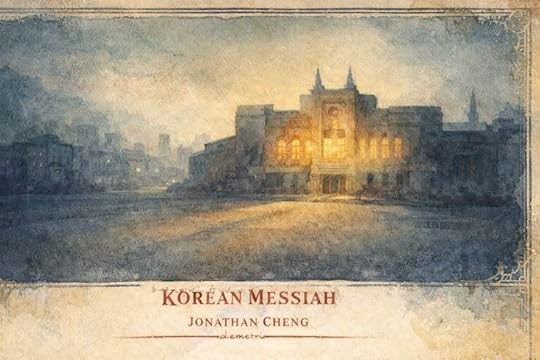
Christian Pyongyang glows here as a lived sacred city, its warmth already shadowed by the later order that will inherit, overwrite, and repurpose its forms of public reverence.
Pyongyang may be the only city in modern political history forced to survive being holy twice. Jonathan Cheng opens “Korean Messiah” with Billy Graham in North Korea in 1992, standing under a portrait of Kim Il Sung and then beneath a slogan praying for the leader’s eternal life. All this in a city once so thick with churches, seminaries, and prayer meetings that it was called the “Jerusalem of the East.” Shown the thatched hut presented as Kim’s birthplace, Graham remarks that all they are missing are the manger and the three wise men. A lesser book would uncork itself on the spot and spend the next four hundred pages admiring its own cleverness. Cheng does the harder thing. He treats the scene not as proof but as a problem. What had to happen to a city for that joke to land so perfectly?
His answer is a civic religion torn up and relaid. “Korean Messiah” is not most interesting as a book arguing that North Korea is somehow like a religion. Plenty of readers will arrive ready for that. What Cheng actually gives them is stranger and better: a history of succession. One sacred public order gives way to another. A city once organized around churches, schools, seminaries, prayer meetings, missionary households, and Korean Christian ambition becomes the capital of a state faith lashed to one family. Resemblance is only the surface. Succession is the engine. Cheng’s strongest proof is not analogy but replacement: he reconstructs the earlier religious infrastructure so fully that the later Kimist order starts to look less like an exotic aberration than a confiscation of forms the city already knew how to perform.
That shift gives the book its authority and leaves a bruise on every chapter after it. Cheng is not simply pointing out that Kimilsungism developed rituals, icons, holy anniversaries, and sacred language. He is rebuilding the earlier world that makes those later forms feel less like invention than seizure. His claim is not that North Korea borrowed a little church furniture. It is that the regime rose in a place already practiced at making reverence public, ceremonial, and hard to escape. Once that possibility is in view, the book stops reading like a stunt and starts reading like a serious, unsettling act of historical recovery.
The structure looks plain and then springs. The manuscript is arranged in a prologue and three acts, with the first explicitly titled “The Jerusalem of the East.” Act One begins far from Pyongyang, in Madison, Indiana, where Samuel Moffett comes of age in the moral weather of postbellum American Presbyterianism. Cheng catches that world in its small materials: missionary journals, prayer meetings, abolitionist colleges, the brisk certainty of people who believed they were exporting both salvation and civilization. From there he crosses into late Chosŏn Korea and the rise of Protestant Christianity in the northwest, until Pyongyang appears not as a mere mission field but as a Christian capital in fact. Act Two carries that world through the Kim family, Japanese occupation, anti-colonial struggle, and the Christian-nationalist networks of Manchuria. Act Three shows the full canonization of Kim Il Sung: mythic birth, doctrinal text, ritualized portrait care, sacred anniversaries, the Chuch’e calendar reset to 1912, and the final cold joke of an “Eternal President.” This is not a filing cabinet. It is the argument’s machinery.
Had Cheng begun with the cult and then tucked Christian Pyongyang into a few chapters of suggestive background, the argument would have looked too pleased with itself – a thesis out hunting examples. Instead he makes readers spend time in the earlier city: the pews, schools, seminaries, meetings, and households that gave Pyongyang its Christian density. Only then does he show what replaced them. The later Kimist order is never just bizarre. It is double-exposed. The city had practice in making holiness civic. That decision is what gives the book its emotional force. “Korean Messiah” is a work of political history, yes, but it is also an elegy for an erased urban memory.
That is where Cheng earns the premise. “Korean Messiah” is strongest when it shows belief as infrastructure. Not private piety. Not Sunday upholstery. Infrastructure: schools, patronage, print culture, family prestige, emotional discipline, ritual attention. By the time the Kim state demands reverence before portraits, memorization of texts, sacred birthdays, floral offerings, and submission to a leader who survives death, Cheng has done enough historical work that the comparison no longer feels ornamental. He has shown a city whose civic life already knew how to stage devotion in public. The later cult does not merely resemble religion. It rises in a place where the techniques of communal reverence had long since been normalized, admired, and woven into daily life.
The book’s best pages understand that power is never satisfied with obedience if it can secure reverence. That insight gives Cheng room to write North Korea not as a sealed freak show but as a legible system. In that sense, the book stands fruitfully beside Barbara Demick’s “Nothing to Envy” and B.R. Myers’s “The Cleanest Race,” both of which helped strip away the lazy mystifications surrounding the regime. Cheng’s contribution is different. He does not chiefly make North Korea intimate, nor chiefly demystify its propaganda. He shows that one better language for the regime may be liturgical. Once you begin reading the state through ritual, icon care, sacred time, pilgrimage, and doctrinal repetition, its durability looks less bewildering and more brutal in its coherence.
The prose earns trust by declining the subject’s standing invitation to gape. North Korea tempts writers into a tone of permanent astonishment, as if every paragraph ought to arrive in a trench coat lined with exclamation points. Cheng keeps his footing. His sentences usually move at a medium stride, wide enough for context but quick enough to keep the page moving. He likes a scene with a heartbeat and then a widening into institutional explanation. Just as importantly, he knows when to return to the thing itself: the white cloth over a subway seat Kim once occupied, portraits wrapped in vinyl after floods, the blood vow at Kija’s Tomb, the churches and schools of Jilin where the young Kim Sŏng-ju moved among Christian-nationalist circles. He explains plenty, but the prose never curdles into filing-cabinet English. Nor does it swoon. That restraint is part of the proof. The thesis comes in on objects.
Cheng also understands recurrence. Birth, text, ritual, image, holy time, eternal life – these pressures keep returning until the echo starts ringing on its own. When Kim Il Sung’s afterlife is organized through calendars, flowers, constitutions, songfests, and sun language, Cheng does not need to clamber onto the furniture and announce that something religious has happened. By then the reader can hear the liturgy unaided. That recurrence gives the book an intelligence beyond paraphrase. It lets the argument accumulate rather than declaim. What lingers is not a single bright thesis statement but an afterimage: Christian Pyongyang ghosting Kimist Pyongyang, one city serving two incompatible sacred orders in sequence.
He is most convincing when the history stays insistently concrete. Kim Hyŏng-jik praying and weeping at Kija’s Tomb before signing a blood vow for national salvation. The young Kim passing through the orbit of Rev. Son Chŏng-do in Jilin. Billy Graham recognizing, with a pastor’s gallows humor, a familiar sacred choreography in a city once Christian in fact and later Christian chiefly by displacement and theft. Kim Il Sung himself saying that without Rev. Son Chŏng-do there would never have been “a Kim Il Sung existing in the world.” These scenes do not decorate the thesis. They carry it. They are the places where Cheng’s large interpretive wager feels least like interpretation and most like disclosure.
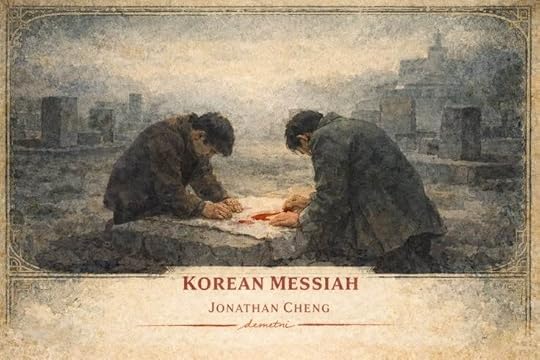
Here private prayer hardens into public destiny, as devotion, sacrifice, and nationalist longing gather into a ritual that feels both intimate and ominously historical.
The strain arrives when Cheng’s master insight starts acting like a master key. Christianity is the privileged through-line here, but his own evidence crowds the claim: Confucian hierarchy, Japanese emperor worship, Bolshevik ideas, Stalinist organization, indigenous religious currents, and the blunt old tools of fear and force. Cheng knows this. He says so, implicitly and sometimes directly, by assembling a history far messier than any single line of causation can comfortably hold. Even then, the book sometimes presses the Christian parallel past its sharpest evidence. It is strongest when it shows transformation on the page. It is weaker when resemblance starts doing causal work it has not fully earned. Demonstrated inheritance is one thing. A total explanation is another.
That limitation matters because the book’s central line of thought is so good. When a writer discovers a genuinely illuminating framework, the temptation is to let it keep winning long after it has made its point. “Korean Messiah” occasionally yields to that temptation. The later sections can feel slightly over-governed by the need to bring every strand back under the same interpretive canopy. This does not sink the book. Far from it. But it does place a ceiling on how fully the history can resist the elegance of its own design.
There is a second cost as well. Early in the book, figures such as Moffett, Kim Hyŏng-jik, and Son Chŏng-do arrive with real local grain: motives, surroundings, contradictions, social weather. Later, as the cult apparatus expands, some secondary figures flatten into positions within the design. You can feel the trade. Cheng has chosen scale, architecture, and conceptual reach over full human density. Here that choice is mostly worth it, though not free. The book’s most durable impressions are therefore likely to be cities, rites, objects, and reversals rather than secondary characters one cannot shake loose.
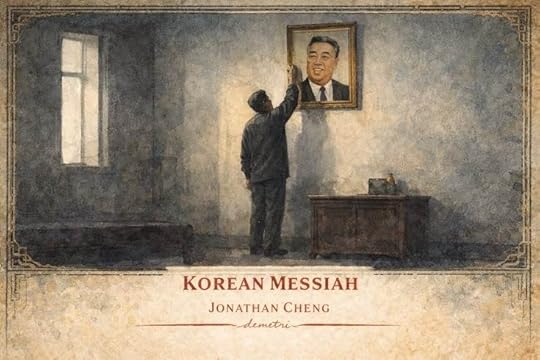
In this spare interior, ordinary domestic order has been taught the posture of reverence, and the room itself begins to resemble a shrine built for obedience.
Its relevance begins with ritual. Cheng is not writing allegory, and he does not need to drag the present onstage to make his point. What “Korean Messiah” clarifies is how thin “force alone” sounds as an explanation for authoritarian durability. Force can make a state obeyed. Reverence, ritual, calendars, sacred birthdays, portrait care, and doctrinal study can make it feel inevitable. That is the book’s present-tense bite. Not that every modern strongman is secretly a priest, or every polity a church in waiting, but that power becomes harder to dislodge when it annexes the forms by which people organize awe, repetition, belonging, and time.
For me, “Korean Messiah” lands at 89/100, or 4 stars: a formidable work of narrative argument, formally intelligent and bold in how far it lets one line of influence run, though not quite free of the strain that shadows a thesis this intent on coherence. For a book this daring, that pressure is a tax, not a disqualification. Cheng’s most illuminating line of thought is not that North Korea learned to behave like a religion. It is that Pyongyang had already known, in another key, how to make belief public, ritualized, and hard to escape. By the end, the city once called the “Jerusalem of the East” has not ceased to be holy. It has simply been retaught where to kneel.
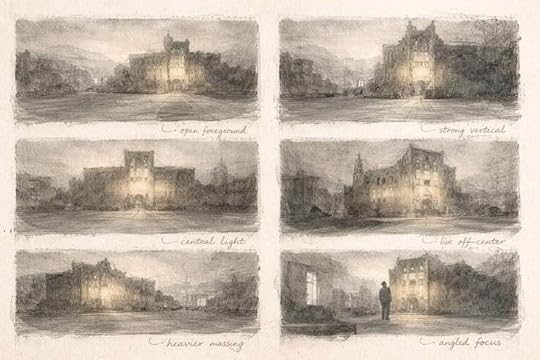
Early thumbnail studies testing how one city might hold two sacred histories at once, with space, geometry, and imbalance doing the work before detail arrives.
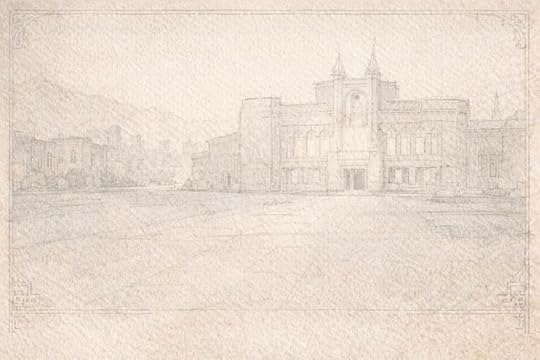
The underdrawing reveals the hidden architecture of the final image, where street lines, wall planes, and vertical pressure quietly prepare the painting’s emotional logic.
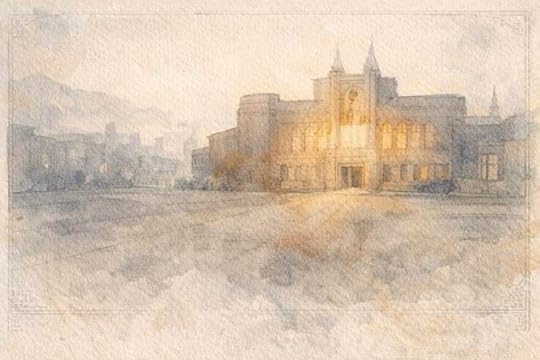
At the first-wash stage, the image begins to breathe, as cold civic light and fugitive sacred warmth separate into the mood the finished painting will carry.
These palette trials map the tension between mineral state severity and the softer afterglow of erased faith, translating the book’s cover logic into watercolor weather.
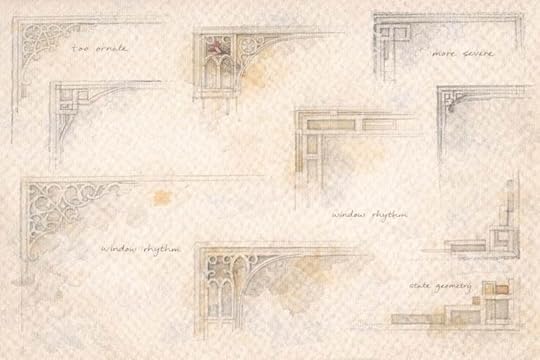
A border study tracing how ecclesiastical softness and monument severity can meet at the edge, so that even the frame participates in the painting’s divided holiness.
All watercolor illustrations by Demetris Papadimitropoulos.
Jonathan Cheng's "Korean Messiah" is a dense history of the connection between Christianity and Kim Il Sung. It is a throughly researched history. of the growth of Christianity on the Korean Peninsula and its impact on North Korea's despotic leader Kim Il Sung. The writing is scholarly and at times moves a bit glacially. That said, the insight that Cheng shares make it a worthwhile read. Thank you to #netgalley and #knopf for the opportunity to preview this book.
Thanks to NetGalley and Knopf the eARC in exchange for my honest review.
I had some trouble getting through this book, but I think most of my issues (missing numbers, making dates impossible to figure out, and missing double f, meaning official came out oicial) will be fixed in the final version. That being said, this is an extremely well researched and thorough history. Cheng does a great job of covering the Christian roots. The book was really interesting, and it was really timely, too.
Thank you to NetGalley, Knopf, Pantheon, Vintage, and Anchor for providing me with this ARC!
All opinions expressed are my own.
4.7/5⭐️
This book was definitely a new topic for me and it did not disappoint. The author dives into and examines Christianity in Korea and the various ways in which it impacted everyone. This book is an in-depth academic account and I can say I’ve learned something new.
[ARC Review] This book is an interesting look into Christian evangelicalism and missionary impact in Korea (North particularly and South). You think you've seen all the impact (good and bad) from American Christianity but this is enlightening. Its dense due to the sheer amount of evidence and slow argument, which is needed. It is thorough and exposes counterarguments not previous to this topic. I enjoyed this book overall and will purchase a physical copy!
Engrossing and thoroughly told story of N Korea's roots in Christian ideology. While I appreciated the great lengths the author took to include as much information as possible, the reading experience began to feel redundant at times.