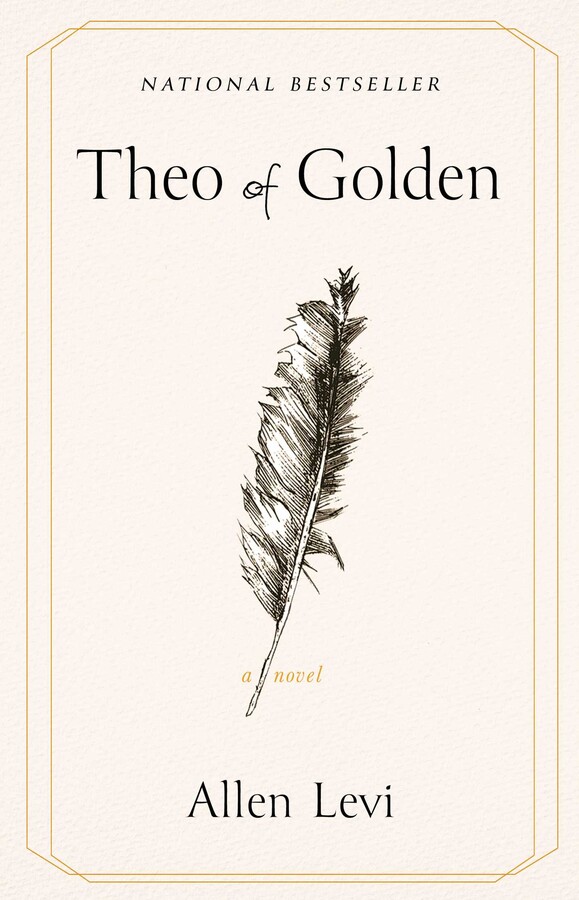
One spring morning, a stranger arrives in the small southern city of Golden. No one knows where he has come from…or why…
His name is Theo. And he asks a lot more questions than he answers.
Theo visits the local coffeehouse, where ninety-two pencil portraits hang on the walls, portraits of the people of Golden done by a local artist. He begins purchasing them, one at a time, and putting them back in the hands of their “rightful owners.” With each exchange, a story is told, a friendship born, and a life altered.
A story of giving and receiving, of seeing and being seen, Theo of Golden is a beautifully crafted novel about the power of creative generosity, the importance of wonder to a purposeful life, and the invisible threads of kindness that bind us to one another.
Published in 2023, I selected this book due to the average review for it being incredibly high, one of the closest to 5 stars I have seen. Upon finishing it, I wavered on making this a 2 or 3 star review (since can’t give 2.5) and finally dropped it down to 2 as I really just wanted to book to be over almost from the time I started it.
The premise seemed intriguing enough- an old man purchases portraits from a local artist, locates the person depicted, and bequeaths the portrait to them. The tagline for the cover was “Stories are told; friendships are born; and lives are changed.” Given the current atmosphere, I looked forward to a book that was going to focus on generosity and kindness.
But the first portrait that captures Theo’s attention is of a man whose child was injured in a car accident. We later find out it was caused by a driver who fell asleep and who was “an illegal”. The tone of this brief passage made me stop a second and wonder if this was going to be a maga supporter book. As such it made me feel a tad uncomfortable where this story of kindness was headed and exactly whose idea of kindness and Christian-like behavior we were going to witness.
Then the second portrait highlighted was that of a woman who Theo thought seemed sad. When he bequeaths her with the drawing, this woman tells Theo, a total stranger, her whole life history including that her cold, awful dad had “made” her get an abortion as a college student vs bringing disgrace on the family. She was now a successful CPA but was indeed very unhappy. She tells Theo she wants to be “just a housewife”. That would make her so happy. The way this conversation was written gave me pause again on so many levels. It just did not sit well with me at all. And it started to feel a bit preachy.
Soon Theo meets rascally Tony the bookshop owner. He seems like a big joker or clown always teasing others. He ridicules Theo for believing in heaven. It is at this point that I realize the author is indeed a religious man. And while the genre is listed as Literary Fiction, the book is definitely leaning heavily towards being a Christian book. So you know Tony is going to have a come to Jesus moment later in this book (pun intended lol).
Overall I found it tedious and just kept pushing on through the chapters, frequently skimming the flowery,extraneous sections of which there were many. The text felt forced and flat, and just, I don’t know, like the author thought the reader wasn’t that perceptive. I saw another reviewer used the term Pollyannaish to describe this book and that is spot on for me. The scenarios seemed pretty unlikely and many of the conversations were unrealistic IMO. I suppose the premise of the book is that Theo can elicit heartfelt responses from others but to witness so many strangers telling him their deepest darkest secrets and regrets and fears just was way over the top for me.
There were parts I did enjoy such as the empathy and kindnesses that Theo showered on those around him. For example he tells one woman that he picked her portrait as the first to be bequeathed because she looked like the kindest person of all the portraits on the wall, You can feel how that compliment touches her deeply. I also did like the ripple effects from Theo’s words and actions.
The ending felt abrupt but at least tied everything up fairly cleanly.
So while the premise of the story was one i desperately wanted to love and enjoy, the manner in which it was written failed to resonate with me. I don’t think I was the right demographic for it perhaps.
I mean no disrespect to the author with my review. It takes a hell of a lot of courage, dedication, and hard work to write a novel. Not every book for is for everyone, and I hope one day when I write one there will be people out there who read it and appreciate it enough to provide thoughtful feedback.
Now, onto my review: There’s a lot to love about this book, but equally as much that didn’t hit the mark for me. I agree that the writing is exquisite and I was moved multiple times, but it wasn’t enough to excuse what I felt was a glaring lack of story. Once it became clear that Theo was an old man with a secret I was intrigued and curious to see where the story would go. The scene where Theo shares a secret with Mr. Ponder that we aren’t privy to heightened this interest. Unfortunately, the topic of Theo’s “plan” was only revisited after the needlessly massive middle section became devoted strictly to Theo’s bestowals and his budding friendships. From a storytelling perspective, it’s presumptuous to assume your readers will remain engaged just because you promised them a secret in the beginning and spend the remaining 350+ pages doting over pretty landscapes, the kindness of humans, and the ability to convey both of those things with beautiful language but never raise the stakes enough to merit such a long wait for the reveal in the first place. At the end of the day, the cardinal rule of storytelling is keep the reader engaged. There was no clear narrative that propelled the story forward in my opinion, just simply the promise that we might eventually figure of what Theo’s big secret is. For me, that wasn’t enough and certainly didn’t justify a 400 page novel. It felt bloated with brilliantly beautiful exposition, but not much more. All that said, the ending STILL had a wonderful emotional payoff, which goes to show how much more wonderful this novel could have been if it were edited down and injected with a bit more plot. That is my opinion and I mean no harm by it. Many people love Theo of Golden. You might too. It’s worth checking out.
Gonna try not to exaggerate. 5 (one million) stars. I want (need) someone (everyone) to read this book. I caught myself smiling while reading on multiple occasions. I laughed and cried. May we all long for heaven the way Theo does, and in the mean time seek to act and serve “on earth as it is in heaven”.
I wanted to love this book. Unfortunately it was a huge disappointment. In spite of the fact that Mr. Levi tried to use every adjective in the English language, the writing was actually incredibly shallow. Way too many characters (none of which were realistic or relatable). Too preachy. Dialogue that was exhausting.
A small town, a coffee shop with beautifully displayed portraits and an octogenarian with a purpose.
What an enchanting read. Theo, 86, is visiting Golden, Georgia. He lives in the moment- appreciating nature, art, music and humans. He leads a quiet life. When he drops into a cafe, he is quick to notice the 92 portraits on the wall. He studies each and every one. This is where the story begins.
Every portrait is purchased and bestowed to each person it belongs to. Theo meets each one and they share their story with him. He then shares what he sees the individual in the portrait to be. An act of kindness which is spiritually uplifting. A story of giving and the joy in receiving.
I, too, “have tasted heaven” reading this. Magnificent***** 5⭐️ A massive thank you to Tracy who was generous in bestowing this precious story to me. 💕
I think the premise is great. I think the imago Dei message embedded in the story is wonderful. I like the idea of this Promenade community.
But, this book needed a lot of editing. I love a doorstop of a book, don't get me wrong, but I felt like parts of it dragged on and it would have been stronger if it was 100 pages shorter. Some of those slow spots in the story had to do with the author telling us everything he knows about art, music, and literature. I felt Theo was too well read, too knowledgable about art, and impossibly knowledgable about music to be a believable character. Few people have mastered so many diverse interests, and it seems to me that the author was trying to prove that he was Theo by including all of these details. (The chapter on Simone's recital...oof.)
For a self-published novel, this book is head and shoulders above its peers. But, I could still tell that it was self-published because it needed so much editing. It's trying so hard to be literary fiction without relying on plot to propel it forward, and yet, I needed more plot points along the way to get to that ending.
When I see all the rave reviews, I wonder how many of those readers are reading a lot of fiction regularly. If you don't cross over into fiction much, I can see the appeal of this book for it is wholesome and warm. There is plenty to enjoy about the characters. (I loved Ellen's story.) But, editing would have put taken this novel from good to great. I hope a publisher will pick up the author's next book because he is a talented writer. But all writers, even the best ones, need a good editor.
DNF. Sneak attack Christian novel. If that’s your jam though then I think you will love it! It’s triggering my religious trauma so I’m out homie. Made it 30% through. Final straw was “I’m not sure I know the answer to that either. But God does.”
If you're looking for a book that consists entirely of impossibly wholesome characters swapping gratuitous speeches of gratitude over the most inane observations of an unrealistically wholesome life, this is it. Bland.
Goodness gracious, what an utter treat this book was! It was the feast for the senses, particularly focusing on light and color and for the heart with the delightful array of characters you get to know better and better. I teared up multiple times being allowed into their stories and bawled like a baby at the last few chapters. Levi has such a warm, kind, and genuine tone and isn't afraid to explore hard situations but makes it alright in the end. Much like the artwork and music and people in the book, this book is a Masterpiece and is one of my top books of the year.
Theo of Golden is billed as a feel good story about kindness and friendship with 'small town in the big city' vibes. If it had stuck with the blurb on the back of the book, it would have been quirky but cute. However, the blurb was nothing more than a money-grabbing bait-and-switch. As long as you are a fan of Christian proselytizing that goes from subtle suggestion to outright metaphors of Theo as God, then you will likely enjoy reading this book.
Not only was I irritated by the repetitive biblical lessons, I was also annoyed by the way the author portrayed any character that wasn't a white European male. Black characters spoke in dialect while white characters had perfect English grammar. "God sees. The Eye o' God sees. The Lawd God sees it all. He keepin' sco'. That's why the grass don't grow up under dem trees." The only Latino character in the entire book was described as "the illegal" who couldn't speak a word of English, and of course was in prison awaiting trial. Women were poor creatures if they never had the chance to experience motherhood. Despite being a large city, Theo never interacted with a single gay person despite the story centering around a popular coffee shop. This was probably for the best because who knows what stereotypically way the author would have described such a character. Fortunately for Theo, every character was a saintly heterosexual.
The other thing that really bothered me about this book was how Theo responded if someone didn't take kindly to his "bestowals". The one time a character--rightfully--said, hey this is really creepy, old man, Theo's entire demeanor changed. He went from a kindly grandfather to an aggressive, vitriolic antagonist, calling the other character inappropriate names. The lesson to be learned: how dare you defy your God! Another time when a character had the audacity to sit down on the bench Theo wanted to use while talking on his phone, Theo behaved so poorly to him. Apparently, Theo forgot he didn't own the public park and everything didn't revolve around him.
But then again, I'm not really surprised by these things based upon how Christianity can operate. Theo, as a proxy for Christianity, perfectly personifies the mentality: Do what I think is Christian and everything is wonderful, but step outside my values and watch the serpent emerge.
There will be an audience for this book. It just wasn't me.
A heartwarming, incredibly written story about the power of kindness.
This story is about a mysterious older man who moves to the small Georgia town of Golden from NYC for one year. On his first day in town, he stumbles upon a coffee shop, and while sipping an exquisite cup of espresso, he sees 92 portraits of residents of Golden hanging on the wall. Done by a local artist, Theo is shocked by how incredible they are. He decides the subjects should own the portraits, so he starts the process of buying them and bequeathing them to their rightful owners.
This book is good for the soul. A great way to start the year. It made me want to slow down and savor the little things.
I do not want to take anyone by surprise. There are some religious, specifically Christian, themes in this book. I didn’t find it preachy, but depending on your relationship with religion, I thought it was worth a mention. I will say it seems like the best parts of Theo are the best parts of all religion, spreading kindness, being good to people, etc.
I enjoyed this book. If you read it, I hope you do too! The perfect pairing would be a glass of port from the Douro wine region in northern Portugal or a cup of espresso. Slow down & savor.
if you didn’t notice the Christian-MAGA framework, it’s not because it isn’t there .. it’s because it was written for you.
If you’re a T supporter who voted him in...who wants reassurance you’re still a good, kind person, this book will pat you gently on the head.
If you say “reading isn’t political” and mean “don’t make me uncomfortable,” you’ll love it. If you enjoy stiff, flat, over-explained prose that never risks a thought, a feeling, or a soul .. welcome.
If abortion should only ever appear as lifelong regret, never choice, this book agrees with you quietly. If you like the old “civilized vs. savage” hierarchy rebranded as “kind vs. broken,” same message, nicer font.
If you want white savior energy, Christian-coded morality, and moral superiority .. but softly, politely, and with vibes .. this is your comfort read.
The writing is stiff, list-like, and emotionally overexplained. Scenes don’t move; they accumulate. Feelings are pointed out instead of embodied. Nothing breathes, nothing risks ambiguity, and nothing is allowed to go wrong. That flatness isn’t accidental — it makes the message easier to swallow.
Abortion is framed exclusively as lifelong regret and shame, never as choice, agency, or complexity. Motherhood is sanctified as destiny. Career ambition is treated as cold pragmatism, while domestic longing is presented as moral truth. These aren’t explored ... they’re affirmed.
The courtroom arc makes the ideology unmistakable. Mendez does not gain agency. Mendez does not speak meaningfully. Mendez does not refuse, question, or resist. He exists solely as the object through which a white character demonstrates virtue. The Black father’s forgiveness is guided to him by the white morally superior perfect white savior .. reads less like grace and more like moral posturing .. a performance meant to reassure the reader that we are still good people.
Racial Hierarchy Without Slurs (The Polite Version) The racial roles are fixed: Theo (white, European, wealthy) → moral interpreter Kendrick (Black) → grief refined into forgiveness Mendez (Latino immigrant) → silent object of mercy Theo is the bridge. Which means others are the terrain. This isn’t accidental representation. It’s narrative control.
The book claims to celebrate “simple acts of kindness,” but every meaningful act requires extreme wealth: elite lawyers medical intervention legal leverage quiet financial coercion Theo doesn’t model kindness .. he purchases outcomes. The average reader cannot replicate his morality. So kindness becomes aspirational theater, not ethics. That’s not humility. That’s philanthropic superiority disguised as virtue.
In short: perfect for readers who want to feel affirmed, elevated, and absolutely right… without their brain breaking a sweat.
I simply do NOT understand the rave reviews. They can’t be real. This book was such a bore. I couldn’t connect to the characters. It was a slog… so much writing about nothing. I skipped the middle and read the end to see what the big deal was. Glad I didn’t waste my time- it wasn’t worth it. DNF at 20%.
“We all walk roads of various descriptions in life. The long and winding road. The road to ruin. Easy street. The road less traveled…. but God in His sublime goodness, has always sent others, mysterious others, to walk with us, - prophets, preachers, friends, teachers, artists, storytellers, wives and husbands, children, songbirds and rivers, even hardship and loss- to help us see clearly. They call us to be fully alive, or at least more alive than before we met them.”
In today's episode of Marquise's Cheery Tales, we have this indie gem recommended by my friend Karen.
She promised: a. It'll make me smile, b. It'll make the think, c. It'll make me smile and think.
(Hey, if you know me at all, you are aware that I don't multitask with these, all right?)
I don't like contemporary fiction, for reasons, and usually am not into indie publishing unless it's in my favourite genres, but I do like the sound of this story. The New York to Georgia setting is also appealing, because silly "city slicker" Yankee-in-the-South comedies were my bread and butter back in the day, though I'm not sure if this is a comedy or not. Promising!
Update November 2025:
Well, 2025 is really invested in becoming my worst year for books, isn't it? Few read, long slump, and I've DNFed books after years without doing that. Must be the 25/25/25 curse or something along those lines!
With much sadness, I have to report that I'm abandoning this book after a couple of chapters, crossing my fingers that the lovely friend who recommended this to me doesn't hate me. 🥹
It's simply not for me, it doesn't stand a chance to be an enjoyable read by the end of the story as things are in the beginning, neither Theo nor the cast of characters seen so far are appealing to me, and I think I've seen the plot before (Where? I'm trying to remember), and at this point in life I prefer not to finish well-recommended books I can see in advance will not get a good reaction from me. I don't think this book deserves one of my rubbishings, either, as it's evidently written for a certain public. I happen to not feel I'm that public, and to retire from the room when the orchestra is still playing is the best for me.
*update- after feeling pressure from the internet to love this book and not rate it low, I’m sticking to my guns. This is a 3 ⭐️ book.
Theo of Golden is one of those books that hooked me right away with its premise. A mysterious stranger shows up in a small Southern town and starts buying up portraits from a local coffee shop. It’s such a cool setup, and the book is at its best when it slows down and lets us sit with those character moments. Some of the little stories behind the portraits are genuinely sweet and thoughtful, and the whole idea of returning them to their “rightful owners” really worked for me.
But overall, it didn’t totally land. The pacing felt slow in places, and some scenes leaned a little more symbolic than grounded, which kept me from fully connecting. I also found myself wanting a bit more development from a few of the characters—and even though Theo is supposed to be mysterious, I sometimes felt more kept at arm’s length than intrigued.
There is a lot to appreciate: the themes of art, generosity, and community are lovely, and the writing has this quiet, gentle quality that I enjoyed. I think readers who love contemplative, reflective stories might connect with it more deeply than I did.
And without giving anything away, I’ll just say the ending definitely affected my overall rating.
DNF. I tried more than once because, well just look at the average rating, or ask anyone in the book world lol - everyone seems to be gushing about this book and I just couldn’t vibe with it.
I’ve been trying to put my finger on exactly what it was that turned me off from this story and I think I’ve got it…
Theo reads like a Mary Sue — a character the narrative clearly finds profound without ever proving it.
He drifts through the story endlessly kind, adored, and unquestioned, while I kept waiting for friction, stakes, or literally any reason to find him interesting.
I never bought what the book was selling. And I loathe a Mary Sue.
All that said, most people loved it. And I’m a definite outlier. Might be the only one that felt this way 😅
* * *
I didn’t finish. I just couldn’t get on with Theo and his meandering. I’ll elaborate more in a bit. I tried like 4 times though bc the reviews are out of this world. Sigh. * * * Every single book group that I’m in has high, high praise for this book- particularly the audio. Hope I love it just as much! 🤞🏻💓
When I first heard about this debut novel in January (2026), I immediately placed a request for it at my local library and became #117 on the waitlist. With so many other books competing for my attention, I eventually forgot about it — until it finally arrived for me this month (May 15).
So, what took so long for this book to become so well-known when it was originally published in 2023? Apparently, it was self-published, with only about 3,000 copies in circulation. But then readers started to notice it, and publishers soon began to notice it, too. When Simon & Schuster picked it up in the fall of 2025, it became a blockbuster hit.
Would it live up to my expectations?
Absolutely. And then some.
Eighty-six-year-old Theo is new to Golden, Georgia. He says he is there on business, though readers are left wondering what kind of business could possibly bring him there. Anonymous to those around him, he moves through the town with a gentle, meandering curiosity, savoring the people, places, and beauty around him.
“He gazed admiringly at the first touches of spring.”
But who really is Theo? And what is he searching for?
At its heart, this is a deeply moving love story — not the romantic rom-com type, but one that celebrates the unstoppable magic of human relationships. Lives intersect. Kindness matters. Small moments become transformative.
Through compassion, thoughtfulness, and heart, those people who connect with Theo find themselves deeply touched by the interaction. And, before we know it, as readers, we see change happening in ways both subtle and profound.
“Nothing is what it’s supposed to be if love is not at the core.”
Love is truly at the core of this story. And, woven throughout it all is the mystery of Theo. Why did Theo choose Golden? What truths is he carrying with him?
Be patient, dear readers. Eventually all the secrets will be revealed.
In the meantime, readers can allow themselves to be completely enchanted by this tender, heartwarming, uplifting, and deeply satisfying novel. It is artfully written, poignant, hopeful, and unforgettable. The characters feel achingly real, and Theo is the kind of character who will softly take up residence in readers’ hearts.
In a world that often feels chaotic and uncertain, this story reminds us of the healing power of kindness, connection, and grace. And by the end, I found myself thoroughly grateful to the author for creating a story that left such a lasting imprint on my heart.❤️🩹
“His decision to live small made him larger than life.”
As a lover of literary fiction, I went into this book with high hopes based on the very high ratings and glowing reviews. However, I ended up wanting to DNF at 87%—at that point I was rolling my eyes more than anything. But sunk cost fallacy kicked in and I finished. This review is about to be a doozy. I finished several hours ago and had to process everything that bothered me with this book before writing my review.
Somehow, this book is neither plot driven nor character driven; plot remains the same for the entire length of the novel, and the characters don’t experience any real challenges that lead to growth. Every character is exactly the same person at the end of the story, which made the epilogue laughably pointless. This book needed to be AT LEAST 25% shorter. I need editors to start editing!
Despite the author’s apparent attempts to create “deep” characters, all of these characters are caricatures. The grumpy business man whose only concern is profit, the grown daughter trying to please her father despite her wishes, the blue collar working man who also happens to be black, the undocumented immigrant who just wanted to work hard to provide for his family, etc. Theo himself is a caricature. Theo is kind and generous and that’s all there is to him, which I think is what people like about this story, but that doesn’t make for an engaging read at all. Every single character, for which there are too many, is flat. Long, descriptive, detailed prose does not make a character rich and deep.
This book is dripping with white saviourism and evangelical proselytism under the guise of literary fiction. This is very obviously a book written by a Christian, middle class, white man for other Christian, middle class, white people. The race, social class, and sex of the author was immediately obvious in the characterization of the few people of color and the reinforcement of traditional gender norms with the female characters.
The Christian aspect took me by surprise when it was dropped in seemingly out of nowhere, but it was also introduced in an awkward, unnatural way. I can’t imagine a full grown adult in real life saying “you don’t really believe in that do you?” to an elderly man who’s in his late eighties in reference to his belief in heaven. In a traditional Southern setting at that…The whole story turns out to be one long “parable” sermon where the main character, Theo, is reminiscent of Jesus. And I’m not being metaphorical, there is a literal sermon in the last 10% of the book. To be clear, my issue here is not that this is Christian fiction, my issue is that it is not labeled and advertised as such. It feels like the reader was deceived.
I truly have so much more I could say, but I am baffled by all these five star reviews. Even if I wanted Christian fiction, this isn’t a five star story! I agree with every one and two star review I read. There were some touching storylines and moments of captivating prose, but it was just too much sugar with nothing to balance it out and develop it into a true story.
I don’t normally review books I don’t finish. However, after reading dialogue like this: “The Lawd God sees it all. He keepin’ sco’. That’s why the grass don’t grow up under dem trees.” I decided to DNF it and thought other potential readers should be aware of this type of dialect. Everyone has the right to choose what they read. I chose not to read this.
Yes! Yes! Yes! No wonder it is a National Bestseller!!! "One spring morning, a stranger arrives in the small southern city of Golden. No one knows where he has come from…or why… His name is Theo. And he asks a lot more questions than he answers." "Theo visits the local coffeehouse, where ninety-two pencil portraits hang on the walls, portraits of the people of Golden done by a local artist. He begins purchasing them, one at a time, and putting them back in the hands of their “rightful owners.” With each exchange, a story is told, a friendship born, and a life altered." Such a beautiful story! Unbelievably beautiful!! When a friend said she noticed I added this book to my TBR list, she said you are going to want to move this book to the top, so I did and very thankful for this nudge. This is my second Octogenarian this week and this one brings about peace and love in a state of unrest in our country. When there is so much hate and evil, this simplifies what is important and finds goodness in the world. If we can't find the good, be the good. The smallest of good deeds changes people. "It's a brave thing to live with your eyes open." The last chapter I played it over three times and realized as a Christian, we don't always make the best decisions, but loving others and helping those in need especially in your own community can change lives. An outstanding job by the narrator David Morse. "The book explores themes of generosity, community, and finding holiness in the everyday, though some readers find it slow or overly sentimental, while others praise its emotional depth and focus on human goodness."
I made it a quarter of the way through this book completely enamored. It was touching, heartwarming and beautifully written. Then suddenly it went from literary fiction to Christian parable. The highjacking of the narrative by overtly Christian themes was jarring; something I did not sign up for. It ought to come with a warning of some kind.
This is a 7-star book, one that had me in tears within the first 50 pages. It’s a book that stays with you, you don’t want to end, and leaves you as a better person. Definitely in my top 3 of all time and will certainly be a yearly reread.
Yes ladies and gentlemen, I have finally finished reading this book! For a minute I didn’t think I was ever going to finish this long, lengthy novel. Was this a good story with great messages woven throughout? It sure was. Was our main character, Theo, a kind, gentle old soul? He sure was. However, I didn’t feel the need to have almost 400 (very wordy) pages go on and on repeating the same message over and over again… Know that every single person out there is fighting a battle we know nothing about, never let your left hand know what your right hand is doing, and be kind!
In this story we have Theo, who goes to a little town of Golden. Theo is an elderly man of 86 years old, he currently lives in New York City, but he was born in Portugal. Upon arriving in Golden, he goes to a coffee shop, the Chalice, where he sees 92 portraits on the wall, that were all done by a local artist, Asher Glissen. Theo begins to purchase all the portraits, and makes it his rightful mission to make sure that each portrait makes it into the hands of its proper owner.
In making sure that each recipient receives their portrait, a beautiful handwritten letter is mailed to them, and each person is to meet Theo at the Fedder- the local fountain. ⛲️ When the recipient comes to get their portrait, they are amazed at what they see, and they begin to tell Theo their life story. This goes on throughout the story, and Theo makes many friends along the way, including those of his neighbors.
Through the story, we never learn too much about Theo’s life-only everyone around him, as he seems to be a mysterious man. So it wasn’t until the very end of the book when we find out who Theo is, and his connection to Golden, did I really enjoy this story. With that being said, I think if this story was a novella, it would have been a masterpiece (for me). I’m not sure why, but I had a hard time picking this book back up when I wasn’t reading it, and it took me a very long time to read.
I know the GR’s trolls are going to come at me hard in the comments for this review- but that’s okay, I’m getting used to it. They like to bash me whether I love a book, or dislike a book 🤷🏻♀️ This is how I felt about this book, and that’s all I can say. I know many others have enjoyed this book more, so please read their reviews as well.
There were some lovely, wonderful moments and characters in this book, but somehow I didn’t feel what I should when I read books like these. But others loved it, so read it for yourself.
This book is the most beautiful book I have ever read and I think everyone should read it at one point in their lives. Reading it makes you want to be a better person